Blog:What should you do if you injured your ankle? A detailed explanation of how to check the severity and what to do immediately after the injury.

Disclaimer : This article was written by Dr. Evan Jeffries, PT, DPT. This content is provided for general informational purposes only and does not constitute medical advice, diagnosis, or treatment. The information does not guarantee specific results or effectiveness for any particular symptoms or conditions. If you are experiencing persistent symptoms or have concerns about your health, please consult a qualified healthcare professional.
"I twisted my ankle and got injured" At this time, do you not wonder first what you should do?
Depending on the severity of the sprain, both the response method and the recovery period change greatly. In this article, we explain in detail everything from first aid immediately after the injury, to the flow until recovery and return to sport, to how to choose a brace for recurrence prevention. Do not rush, and aim for your return with the correct steps.
In this article, based on the knowledge of Dr. Evan Jeffreys (DPT), a physical therapist who is a Zamst partner, we introduce what an ankle sprain is, how to check its severity and treatment methods, and how to choose ankle braces useful for recurrence prevention and return to sport. Please read to the end.
About the Author
Evan Jeffreys is a physical therapist who obtained a Doctor of Physical Therapy (DPT) degree from the University of St. Augustine for Health Sciences. He is also the owner of Evolving Motion Physical Therapy, has broad knowledge related to the musculoskeletal system, and has treated many orthopedic conditions through a proactive approach to healthcare and lifestyle.
Let us understand the severity of ankle injuries
When you injure your ankle, the first thing you are concerned about is probably "how serious the injury is." There are several types of ankle injuries during sports, but among them the especially common ones are sprains and high ankle sprains. Because the cause, symptoms, and recovery period differ for each, let us understand which type your injury falls under.
Sprain
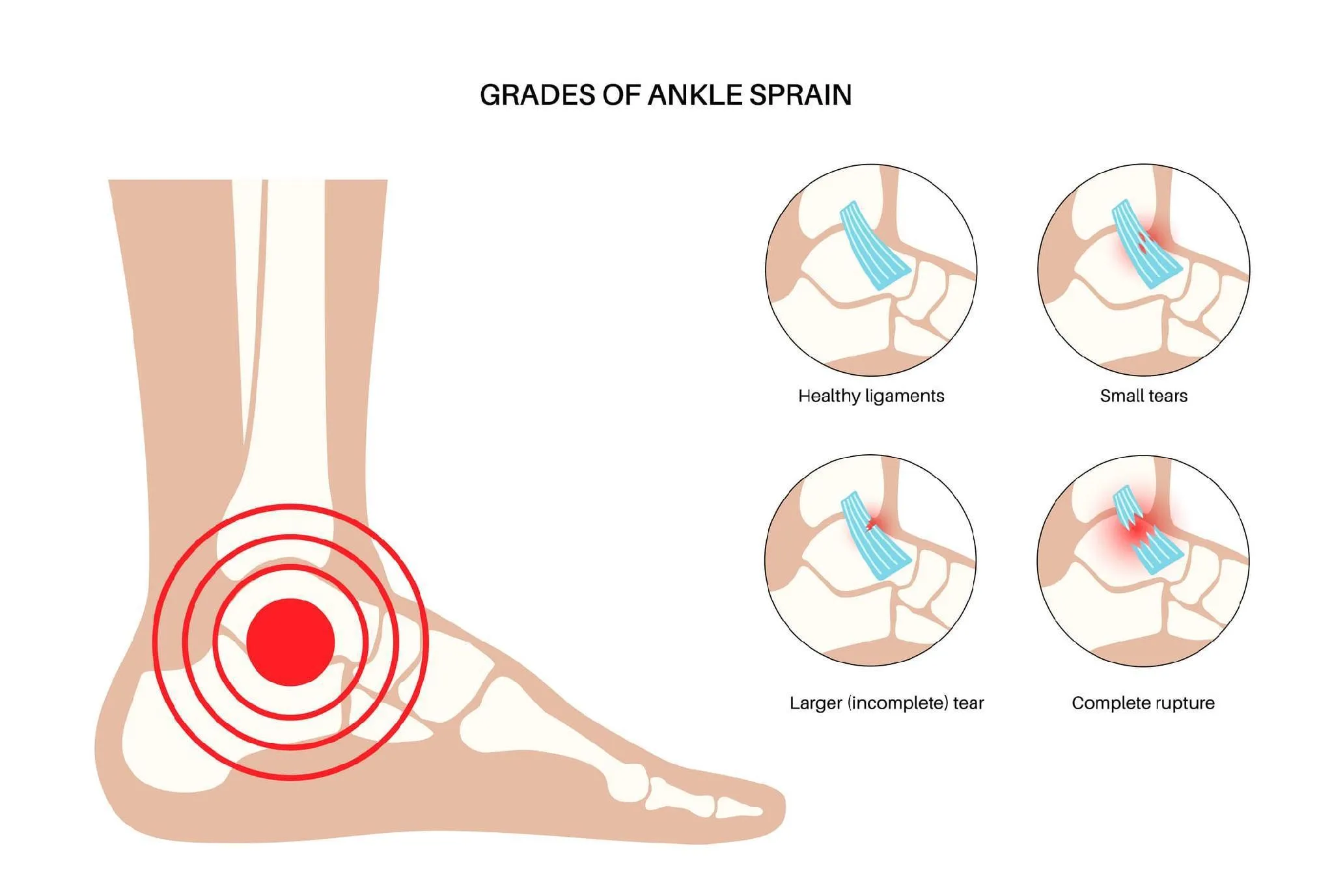
An ankle sprain is one of the most common sports injuries and it occurs when the ligaments in the ankle get stretched or torn。
Symptoms can range dependent of severity of an ankle sprain. Severity is determined by clinical tests and/or MRI
- Grade I: Ligament is stretched not torn
- Grade II: Ligament is partially torn
- Grade III: Ligament is fully torn
*The above grades are for reference only. The correct severity is determined by clinical examination and MRI examination. If you have pain, do not self-judge and be sure to have it seen at a hospital.
For details about cases of sprain, please see "Types of Injuries : ANKLE SPRAIN."
If you would like to see a related blog article, please see "What should you do if you sprained your ankle? Introducing severity checks and recommended braces."
High ankle sprain

A high ankle sprain is a type of injury where the ligament above the ankle joint gets stretched or torn. These ligaments connect the two lower leg bones together creating stability.
Unlike a regular “low ankle sprain” which affects either side of the ankle, a high ankle sprain occurs at the shin. This often makes symptoms such as pain, swelling and difficultly walking more significant than a traditional ankle sprain.
For details about cases of high ankle sprain, please see "Types of Injuries: HIGH ANKLE SPRAIN.”
Why do sprains happen, and what are the causes?
Ankle sprains are the one of the most common lower body injuries in basketball and volleyball. They typically occur when the foot twists or rolls beyond its normal range of motion, causing the ligaments that support the ankle joint to stretch or tear. The ankle can be very vulnerable especially if you don’t have any of the best ankle guards for protection.

Basketball and Volleyball injuries occur in a variety of ways but in terms of typical ankle sprains they happen with these types of movements:
- Sudden change of direction
- Landing from a jump
- Landing on another person’s foot
When you play sports in the future, play while being careful of movements like those above.
High ankle sprains are less common than traditional low ankle sprains, but they are the most severe and difficult to return to sports participation.
High ankle sprains are typically seen as basketball injuries, volleyball injuries, and pickleball injuries.
High ankle sprains occur when there is a sudden twisting or rotating force applied to the ankle and lower leg.
In basketball or volleyball this occurs with sudden change in direction or landing on someone’s foot causing a sudden twist or rotation.
With pickleball injuries involving the high ankle this is typically seen when changing sudden directions to track down a ball and the ankle suffers a sudden twist or rotation.
How to respond immediately after the injury
Immediately after injuring the ankle, first, "how quickly you can suppress the inflammation" is important.
High ankle sprains typically take longer time to heal vs traditional ankle sprains.
In either sprain, the response immediately after the injury greatly affects the speed of recovery afterward.
The response method recommended in the acute phase immediately after the injury is P.O.L.I.C.E.
To heal an ankle injury more quickly, it is necessary to suppress pain and inflammation at an early stage. An ankle brace serves the role of protecting the affected part so that it is not injured further, and also helps suppress inflammation. Please consider wearing an ankle brace from immediately after the injury.
*Immediately after the injury, do not self-judge, and be sure to visit a medical institution. The above response is only first aid.
How long does treatment take?
The healing time of an ankle sprain can vary dependent on severity, ankle protection after the sprain, and how well the ankle is stabilized.
High ankle sprains are less common but traditionally more severe with timelines for healing. Healing time is always dependent on grade level.
- Grade I sprain come with a recovery timeline of 1-2 weeks. (For high ankle sprain, 1-4 weeks.)
- Grade II sprains come with a recovery timeline of 4-8 weeks.
- Grade III sprains typically have a recovery timeline of up to 3 months unless surgery is warranted which would increase the timeline
There are ways that speed up or help with the healing timeline
To speed recovery, in either sprain, actively carry out physical therapy/rehabilitation and ankle protection. Introducing appropriate support from an early stage leads to shortening the recovery period.
Phase-based approach toward return to sport
Recovery from an injury is not "finished when the pain is gone." To return safely to sport, an approach matched to the recovery phase is important. If you try to return in a rush, the risk of sprain or injury again increases. Go through the stages and steadily bring your body back.
Late inflammation stage: increase muscle strength with training
When the ankle pain becomes lighter and you are gradually able to place load on it, let us move to the next phase. In this phase, by incorporating training that trains balance, stability, and proprioception, you will recover range of motion and muscle strength. For example, squats while on a balance ball, etc.
It is important not to rush and to gradually increase the load within a range where pain does not appear.
Just before return: increase flexibility with exercises

When the ankle pain is completely gone and the range of motion has recovered, let us finally start full-scale training toward return to sport. In this phase, perform sport-specific functional exercises assuming actual sports movements, and increase movement quality and flexibility.
For return from a high ankle sprain, the following exercise is recommended.
It is not "it does not hurt, so it is okay"; increasing flexibility while confirming whether you can move as before leads to a safe return to sport.
Benefits of ankle braces
Ankle braces are useful in a wide range of situations, from injury prevention to recovery. Some people may feel, "Are braces really necessary?" but considering the burden on the ankle during sports, their effect is very large.
Stability is created
When you wear an ankle brace, you can hold the ankle joint firmly. Because the joint becomes stable, excessive twisting movement of the ankle during sudden change of direction or landing can be suppressed, so the causes of sprain themselves can be reduced. As a result, the risk of injury can also be greatly reduced. Also, similarly, by wearing it during recovery after a sprain, the burden on the ankle in daily movements can be reduced.
Reduce anxiety about ankle trouble
Even if, by any chance, you twist your ankle during competition, wearing a brace has the effect of suppressing the severity of the sprain. If the severity decreases, the period away from the team may also become shorter. Rather than playing while carrying the anxiety that "I might get injured again," by protecting the ankle with a brace, you can create an environment in which you can concentrate on competition.
It gently compresses the ankle
Even after a sprain occurs, by wearing a brace, the ankle during walking is firmly supported and there is an effect of easing pain. Appropriate compression that is neither too strong nor too weak makes daily life and rehabilitation during the recovery period smoother.
For details about ankle braces, please see "ankle brace collection"
Timing for wearing an ankle brace
As above, ankle braces have many merits, but this does not mean "ankle braces should be worn in every situation." By correctly understanding the necessary timing, you can use them more effectively.
During exercise when injury is a concern
When doing sports with a high risk of sprain, such as basketball and soccer, which involve sudden change of direction, vigorous movement up, down, left, and right, or twisting movements of the ankle, wearing a brace is recommended. This is because the more intense the movement involved in the sport, the greater the burden on the ankle becomes. If you wear a brace before play, even if a sprain happens by any chance, it prevents it from becoming severe, making it indispensable for injury prevention.
During recovery after injury
During the recovery period after injuring the ankle as well, let us wear a brace. By firmly protecting and supporting the affected part, it promotes recovery while preventing further injury. Because it can also reduce the burden on the ankle in movements of daily life, it helps recovery proceed smoothly.
When the ankle feels unstable
For people who have repeatedly had sprains many times in the past, and for individuals with chronic ankle instability, wearing an ankle brace can be beneficial in providing ongoing support. These individuals are usually hypermobile, which means their joints stretch beyond the normal position. However, it is crucial to complement the use of braces with exercises that strengthen the ankle muscles.
Should an ankle brace be worn all day? At what times should it be removed?
Outside the wearing timings like those above, keeping the ankle brace off may also promote recovery from injury. For example, in the following cases.
During low-load activities (walking or light housework, etc.)
For everyday activities that do not place significant stress on the ankles, such as walking or light household chores, it might be better to avoid wearing ankle braces. This allows the ankle muscles to function naturally and maintain their strength.
During rest
Giving your ankle a break from the brace during periods of rest, such as when you are sleeping or sitting for extended periods, can help in preventing muscle atrophy and skin irritation.
While ankle braces are undoubtedly beneficial in preventing and managing ankle injuries, wearing them all day may not be ideal for everyone. There should be serious reasons or importance to have to wear an ankle brace all day. It is important to assess your individual needs, the nature of your activities, and the condition of your ankle before deciding on the duration of brace use. Balancing the use of ankle braces with strengthening exercises and proper footwear can help in maintaining overall ankle health and preventing dependency on external support.
How to choose an ankle brace toward return from injury
Next, let us also correctly understand how to choose an ankle brace. Even when we say ankle brace, its types and functions are various. Choosing a brace that matches the state of your injury and your recovery phase is important toward an early return to competition.
Choose by the injured part
Even when we say ankle injury, in a general sprain and a high ankle sprain, both the location and nature of the ligament that is damaged are different. Therefore, the type of brace needed also changes. For example, in the case of a general sprain, if the case is relatively mild, it may be possible to deal with it by taping or with a brace having lighter support strength.
On the other hand, in the case of a high ankle sprain, because the strong ligament connecting the tibia and fibula (the tibiofibular syndesmosis) is damaged, support that fixes the affected part more strongly and firmly is required. As a response to this injury, fixation with white tape and the like can be given as a response method, but wrapping tape requires specialized knowledge and skill. Also, taping may become loose during a game, and in that case it may become necessary to wrap it again.
What is recommended there is a brace that is easy to put on and also has firm fixation strength. If it is a brace with hard guards (for example: A2-DX), it can firmly protect the affected part.
First, after having the part and degree of your injury correctly diagnosed at a medical institution, let us choose an appropriate brace.
Choose by severity
Depending on the severity and grade of the sprain, the fixation strength required also changes. Once you sprain your ankle, the ligaments become unstable and the risk of recurrence increases, so especially when the severity is high, firm protection and support are necessary.
If it is mild (Grade I), light support may be sufficient, but in the case of moderate to severe (Grade II/III), it is better to firmly fix the ankle with a brace with hard guards. A high-fixation brace such as Zamst A2-DX provides very high stability and support strength and reduces anxiety about ankle trouble.
Choose by return phase
The brace needed also differs depending on the period and stage from immediately after the injury. For example, in the acute phase to the early recovery phase, because it is necessary to protect the affected part while pain and swelling remain, a type of brace that can adjust tightness and support strength according to the state of the ankle is suitable.
Before and after return to competition, the support required also changes according to the recovery state of the ankle. At the stage where instability and pain still remain, it is important to firmly protect the injured area with a supporter with high fixation strength. On the other hand, at the stage where recovery has progressed and there is no longer a problem with basic movement, by choosing a supporter excellent in the balance of ease of movement and stability, it is possible to reduce the burden during play while connecting it to recurrence prevention.
In addition, although the support strength is modest, it is also effective to combine and use according to the purpose, such as a compression-type supporter that is useful for light stability and reducing discomfort, as supplementary care at a stage where recovery has progressed.
In this way, while being conscious of which phase you are in now, choosing a support level that matches the
condition of your ankle will become the first step toward a smooth return to competition.
Three recommended Zamst ankle braces
We introduce three high-quality and popular Zamst ankle braces. If any is the ankle brace you are looking for, please consider it.
Recommended for people who want to move quickly | FILMIST ANKLE
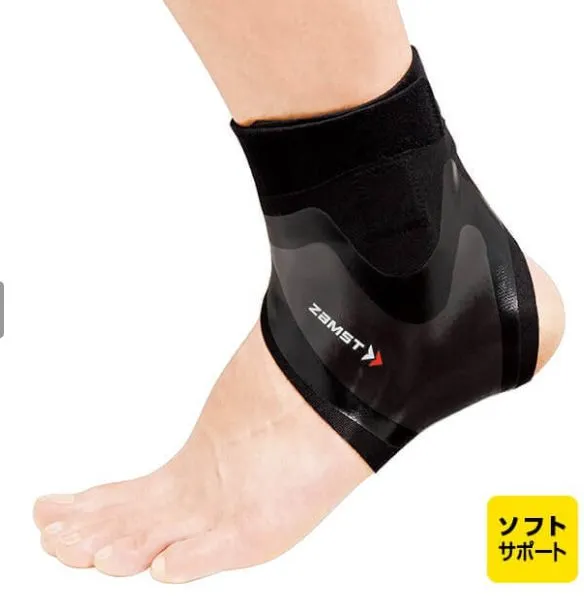
After returning from an ankle sprain, are there not many people who are playing while carrying the anxiety that "I may get the same injury again"? FILMIST ANKLE, while the film part is only 1.2 mm and extremely thin and lightweight, firmly suppresses the inversion movement of the ankle (twisting inward) with a three-layer structure. Because it has a wearing feel that hardly lets you feel that "you are wearing a brace" like this, even after returning to competition you can concentrate on play without hindering movement. It is one piece especially recommended for those who also want to emphasize quick movement.

Voices from people who actually wear it:
- It is very thin and does not bother me even during exercise, and I can also wear spikes without problems. I wear it on both sides, but it works without hindrance to play. I recommend it.
- It can be put on easily, and because the joint stability is solid, it is very helpful. As a physical therapist, I thought I would like to recommend it to my patients as well.
Recommended for people who want both fixation strength and ease of movement | A1

There are probably many people who have the worry, "I want to fix it firmly, but it is a problem if movement is restricted." A1 is a model that pursues a balance of fixation strength and ease of movement, firmly suppressing inversion movement with three-direction straps applying taping theory while not impairing ease of movement with a thin design. It is one piece that can be recommended with confidence to people who think, "I am worried about sprains, but I want to move firmly."
Voices from people who actually wear it:
- Purchased because my daughter who plays basketball asked for it. She said it was recommended by her coach because she played guard on both her team and club activities, and spraining her right ankle had become a habit. When she practiced wearing it, she said, "I do not feel like I will sprain it anymore."
- I purchased it for my daughter who kept getting sprains in basketball. She had been taping every day both when she sprained it and for prevention, but because it took effort and cost, after looking into many things we arrived at this brace. It seems to fix firmly in the same way as when taping, and now she uses only this brace.
Recommended for people who want firm fixation | A2-DX

A2-DX is a model that boasts the highest fixation level in Zamst’s ankle brace series. It broadly supports not only inversion but also eversion and forward wobbling, and with a design that considers ankle movement and skeletal structure, it firmly guards the ankle. It is one piece especially recommended for people who have chronic ankle instability and for people who want to engage in play and practice with peace of mind even during rehabilitation after a sprain.
Voices from people who actually wear it:
- I purchased according to the shoe size chart, and the size fit perfectly! I am also satisfied because the hold feeling is such that I can play with peace of mind.
- It firmly guards the ankle.
Frequently asked questions about ankle braces
We answer frequently asked questions about ankle braces in FAQ format.
Q. If the pain is gone, may I stop wearing the ankle brace?
Even if the pain disappears, it does not necessarily mean complete recovery. Dr. Evan points out that "pain is only one piece of the puzzle." He recommends confirming whether muscle strength, balance, and sport-specific movement have returned, and removing the brace gradually.
Q. Is it possible to use a brace immediately after getting injured?
Do not use it if there are abnormalities such as fracture, wound, numbness, swelling, rash, or dermatitis at the wearing part.
Q. I am using braces on both the knee and ankle of the same leg; is that a problem?
There is no problem with wearing braces on both the knee and ankle of the same leg. On the other hand, compared with before the injury, the injured part may have lower muscle strength or decreased flexibility, so please begin exercise after stretching more carefully.
In addition to questions related to ankle braces, if you would like to know in more detail, such as the timing for wearing braces and how to choose them, please see this FAQ page.
Also, if you would like to know more information specialized in ankles, please also check the ankle category page.
Summary: To return from an ankle injury, wearing an ankle brace is recommended
Ankle injuries are familiar things that anyone who plays sports may experience. However, if you take it lightly as "only an injury" and leave it alone, the risk increases that recovery will drag on or that you will repeat the same injury again. If you get injured, first it is important to correctly understand the severity and quickly begin appropriate response according to the state of the injury.
And among the various response methods, the ankle brace plays a large role. It is useful in every phase, from protection and support of the affected part immediately after injury to prevention of recurrence after return to competition. However, the appropriate brace differs depending on the injured part, severity, and so on. Based on the points introduced in this article, please try choosing a brace that matches the state of your injury.
While facing the injury, let us move forward one step at a time without rushing, aiming for the day when you can again fully enjoy the sport you like.