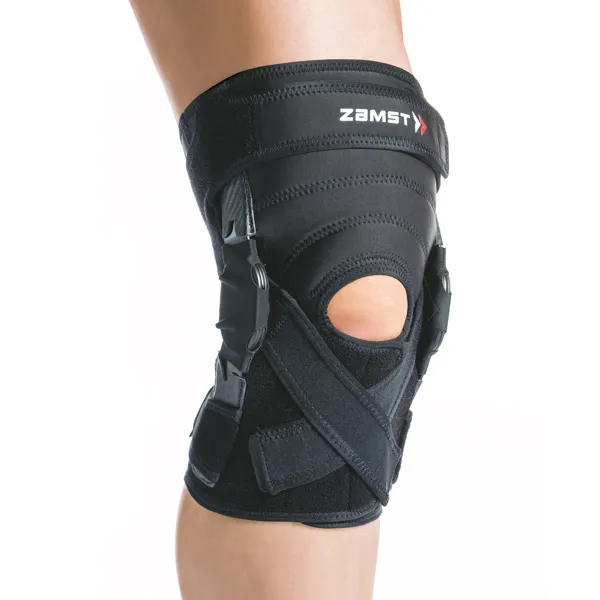


ZAMST ZK-X (Knee support)
For inhibiting lateral and anterior movement
Hinged knee brace providing extra strong support for knee ligaments.
Recommended For
・Athletes seeking maximum knee stability during sports activities
・Individuals experiencing knee instability during dynamic movements
・Athletes looking for a hinged knee brace with strong support
・Players seeking enhanced protection against excessive knee movement
・Athletes who prefer a higher level of stabilization and control
Ideal For
・Activities requiring enhanced knee stabilization
・Managing instability during athletic movements
・Supporting confidence during physical activity
・Athletes seeking maximum support and protection around the knee

Product Description

Good fit and anti-slip structure
Open front panel design of below the knee conforms to calf thickness and shape with large individual differences. This product provides individualized fit.

Patella pads compress around the patella
A semicircular patella pad that gently and precisely compress the patella enhances stability of the knee.

Guard unstable movement
We use lightweight metal hinges that are designed to let you bend and stretch smoothly while it inhibits lateral movement of the knee.

Realizes a comfortable fit
Power double raschel knit fabric that has a combination of breathability and proper compression realizes a comfortable and good fit. In addition, you may stretch and bend the knee smoothly without uncomfortable feeling.

Multiple supports for the movements with double strap
The X (cross) strap on the front and bottom of the main body and the parallel strap on the thigh and the back of the knee effectively compresses to accommodate the movement of the muscles of the thigh and lower leg. They also suppress the anterior movement of the lower leg.

Lightweight metal hinges
Lightweight metal hinges provide high protection.
Size Chart
Measure the circumference of the thigh 16 cm (6.25 in) above the center of the patella. If your measurement falls between two sizes, choose the larger one.

Size
S
M
L
XL
2XL
3XL
4XL
Circumference of the thigh
43 - 46 cm
(17.0 - 18.0 inches)
46 - 49 cm
(18.0 - 19.25 inches)
49 - 52 cm
(19.25 - 20.5 inches)
52 - 55 cm
(20.5 - 21.5 inches)
55 - 60 cm
(21.5 - 23.5 inches)
60 - 65 cm
(23.5 - 25.5 inches)
65 - 70 cm
(25.5 - 27.5 inches)
Instruction
Recommended Products

ZAMST EK-1
Light support for the entire knee

ZAMST EK-3
Support the entire knee for horizontal balance

ZAMST EK-5
Support the entire knee firmly for horizontal balance

ZAMST ZK-MOTION
Comfortable knitted knee brace providing moderate support with excellent mobility

ZAMST ZK-PROTECT
Strongest support for inhibiting lateral and anterior movement

ZAMST JK Band
Reduce the strain on below the kneecap

ZAMST JK-1
Reduce the strain on below the knee in a period of growth

ZAMST JK-2
Reduce the strain on below the knee for jumpers

ZAMST RK-1 Plus
Reduce the strain on the outside of the knee for runners

ZAMST RK-2
Reduce the strain on below the knee for runners
FAQ for this product

Zamst products are designed for sports activities, so you may find that it is not as difficult to move as you might worry. In practice, you should be able to move comfortably.
Most braces are machine washable. After washing, hang them to dry in the shade. Please avoid washing with light-colored items, as colors may fade or transfer to other fabrics. When washing with other clothes, use a laundry net to prevent fraying or streaking. *Hand washing is recommended for some products. Please refer to the instruction manual for specific details (instruction manuals are also available on each product page of the Zamst website).
The Zamst Knee brace is designed for sports use, providing strong compression to apply firm pressure. If you do not require high compression, we recommend choosing one size larger.
First, ensure you have the correct size and follow the instructions in the manual for proper application. Be cautious not to tighten it too much, as excessive tightness can lead to congestion.
Zamst Knee brace is designed to be worn directly on bare skin and is not recommended to be worn over tights. If worn over tights, depending on the material of the tights, the brace may slip off and the desired effect may not be achieved, or the increased thickness of the back of the knee may cause discomfort or pain when bending the knee.
If the size is borderline, we recommend the larger size.
From Dr. Evan Not necessarily. One of the biggest mistakes I see is athletes assuming they're fully recovered just because the pain has gone away. Pain is only one piece of the puzzle. Before I recommend discontinuing a brace, I want to see good strength, balance, confidence, and sport-specific movement. Can you jump, cut, sprint, and land without hesitation? That's what matters. Many athletes feel fine before their body is truly ready for the demands of competition. In most cases, I recommend gradually reducing brace use rather than stopping all at once. The goal is to make sure you're not only pain-free but also physically prepared to handle your sport safely.
From Dr. Evan I usually explain it this way: a knee sleeve is primarily about compression and comfort, while a knee brace is designed to provide more support and stability. Many athletes wear sleeves because they like the warmth, compression, and increased awareness they provide. A brace is generally the better option when there is a history of injury, instability, or a specific condition requiring additional support. As a physical therapist, I help athletes match the tool to the problem. If you're simply looking for mild support and comfort, a sleeve may be enough. If you're trying to manage instability or return from injury, a brace may be more appropriate.
From Dr. Evan It depends on the athlete and the reason for wearing it. Soft braces tend to be lighter, more comfortable, and less restrictive, making them a great option for many athletes. Hinged braces provide additional stability and are often used following ligament injuries or when significant support is needed. For example, most offensive lineman in college and the pros wear hinged braces as a prevention tool for knee ligament injuries because of the nature of their position making their knee very vulnerable to knee sprains. The best choice comes down to your injury history, sport demands, comfort preferences, and the level of stability you're trying to achieve.
From Dr. Evan As a sports physical therapist, I don't believe everyone needs a brace. But there are situations where a brace can be a smart tool. If you had just had an acute injury such as an ankle sprain or knee sprain a brace is a great tool during the protection phase to reduce the risk of further injury and provide stability and comfort. In my clinic, I often see athletes wait until they've been injured multiple times before thinking about prevention. A brace can provide an extra layer of protection during high-risk activities while you're continuing to build strength, balance, and movement control. The goal isn't to rely on the brace—it's to use it strategically to help keep you healthy and performing at your best.
Evan Jeffries, PT, DPT, MS
EVAN JEFFRIES is a physical therapist with a Doctorate in Physical Therapy (DPT) from the University of St. Augustine for Health Sciences. He has vast knowledge of the musculoskeletal system and has treated many orthopedic conditions by bringing a proactive approach to healthcare and lifestyle.