
Blog: 5 Stretches for IT Band Syndrome |What causes it and when to do them

Disclaimer : This article was written by Dr. Evan Jeffries, PT, DPT. This content is provided for general informational purposes only and does not constitute medical advice, diagnosis, or treatment. The information does not guarantee specific results or effectiveness for any particular symptoms or conditions. If you are experiencing persistent symptoms or have concerns about your health, please consult a qualified healthcare professional.
“Looking forward to your run, but worried about that discomfort on the outside of your knee?” Even routine runs can gradually build stress in the knee and lead to trouble before you notice it. If the discomfort sits on the outside of the knee, you may be dealing with IT band syndrome (iliotibial band syndrome).
“IT band syndrome (ITBS) … accounts for one tenth of all running injuries. It is the second most common injury for runners.” (1)
Drawing on insights from our partner Dr. Evan Jeffries, DPT, this article explains what causes IT band syndrome and walks you through five simple stretches you can start right away. Use them to help you keep enjoying running for the long haul.
About the author
EVAN JEFFRIES is a physical therapist with a Doctorate in Physical Therapy (DPT) from the University of St. Augustine for Health Sciences. He is the owner of Evolving Motion Physical Therapy, has extensive knowledge of the musculoskeletal system, and has treated many orthopedic conditions through a proactive approach to healthcare and lifestyle.
What is IT band syndrome?
The iliotibial band (IT band) is a thick, durable band of connective tissue that runs along the outside of your thigh from the hip to the knee. Overuse of this structure can lead to IT band syndrome—sometimes referred to as a type of “runner’s knee” in a narrower sense.
“IT band syndrome is a common overuse injury that occurs when the IT band becomes irritated and inflamed.”
“From a historical perspective ITBS is caused by excessive friction of the distal iliotibial band as it moves over the lateral femoral epicondyle during repetitive knee flexion and extension.”
Beyond the classic “friction” view, research also suggests symptoms may stem from excessive compression of the richly vascularized and innervated fat pad between the IT band and the lateral femoral condyle, not friction alone .

Could your symptoms be IT band syndrome?
“Symptoms of IT band syndrome include pain and tenderness on the outside of the knee, especially during running or other activities that involve bending the knee.”
“You may also experience a popping or snapping sensation in the knee, and the pain may worsen when running downhill.”
If any of the below sound familiar, try the stretches and monitor how you feel:
- Discomfort on the outside of the knee
- Discomfort during runs
- Pain that settles with rest but returns when you run again
If one or more apply to you, try the stretches below and monitor how you feel.
When should you stretch?
In short, before you run. The IT band tends to get stiffer over time when left alone. Priming the surrounding tissues with targeted stretching before you start can reduce friction/pressure during your run and help keep discomfort in check. Make these five movements part of your pre‑run warm‑up so running stays enjoyable.
5 effective stretches for IT band syndrome
Each takes under 3 minutes and can be done without special equipment. Choose the ones that feel best and build a routine you can stick to.
1) Standing IT band side bend (about 1 minute)
The standing IT band stretch is a great way to stretch your IT band before running. Here's how to do it:
- Stand with your feet shoulder-width apart and your arms at your sides.
- Cross your left foot behind your right foot.
- Lean your upper body to the right while keeping your left foot planted on the ground.
- Hold the stretch for 15 to 30 seconds, then switch sides.
This stretch targets the IT band and the muscles around the hip, helping to loosen up the entire area before running.
2) Lateral lunge stretch (about 1 minute)
The lateral lunge is another effective stretch for the IT band. Here's how to do it:
- Start by standing with your feet hip-width apart.
- Take a big step to your right with your right foot, keeping your left foot planted on the ground.
- Bend your right knee, keeping your left leg straight.
- Push your hips back and lean your torso forward, keeping your back straight.
- Hold the stretch for 15 to 30 seconds, then switch sides.
This stretch targets the muscles around the hip and primarily the groin, helping to loosen up the entire area before running.
3) Seated twist (about 1 minute)
The seated IT band stretch is a great stretch to do before running, especially if you're short on time. Here's how to do it:
- Sit on the ground with your legs straight out in front of you.
- Bend your right knee and cross your right foot over your left leg.
- Twist your torso to the right and place your left elbow on the outside of your right knee.
- Hold the stretch for 15 to 30 seconds, then switch sides.
This stretch targets the IT band and the muscles around the hip, helping to loosen up the entire area before running.
4) Foam‑roll the TFL muscle (about 2 minutes)
Foam rolling is a great way to loosen up tight muscles before running. Here's how to do it:
- Lie on your side with the foam roller just above your right hip bone.
- Use your arms to support your upper body and roll on the muscle between your right pelvis bone and your hip bone with the foam roller.
- Roll back and forth for 30 to 60 seconds, then switch sides.
Foam rolling helps to break up tightness of the muscle which will release tension of the IT Band. Remember the IT Band is connective tissue and not a muscle so inherently it will be tight and painful if you roll on it. You should focus on above the IT band to get the most impact on your discomfort.
5) Glute stretch (about 1 minute)
The glute stretch is a great way to loosen up the muscles around the hip before running. Here's how to do it:
- Lie on your back with your knees bent and your feet flat on the ground.
- Cross your right ankle over your left knee.
- Use your hands to pull your left thigh towards your chest.
- Hold the stretch for 15 to 30 seconds, then switch sides.
This stretch targets the glutes and the muscles around the hip, helping to loosen up the entire area before running.
There is also a video supervised by Dr. Evan, so please check it out.
Important: Stretching is just one tool to ease discomfort. Always listen to your body. If you feel pain, stop and rest. Consult a healthcare professional if needed.
Knee braces that help with IT band issues: features and benefits
Alongside smart warm‑ups, wearing a knee brace can be a useful option for preventing or reducing IT band–related discomfort—especially during runs.
Braces that reduce rotational stress
A brace designed to limit knee rotation can reduce unnecessary load on the joint, helping to control lateral sway and external/internal twist that aggravate the outside of the knee and keep your stride more stable.
Braces that provide gentle, full‑knee compression
Many knee braces use compressive materials (e.g., neoprene) and fit snugly—like a close‑fitting sleeve—around the knee. That light compression can deliver a reassuring, supported feel and enhance stability during activity, which is helpful for runners worried about knee trouble.
Recommended: Zamst RK‑1 Plus knee brace
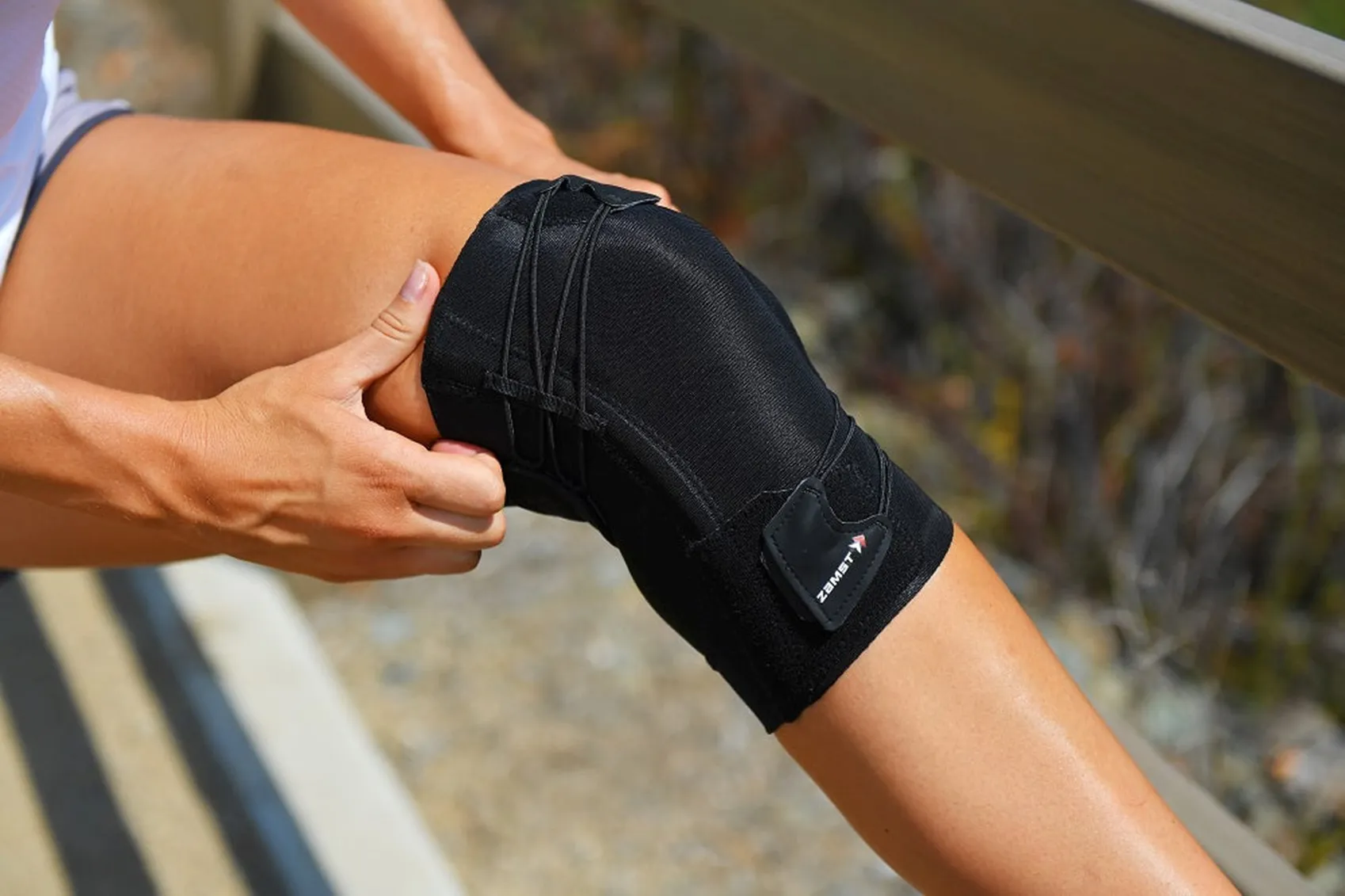
Among various options, Zamst RK‑1 Plus stands out as a high‑quality brace designed to help with outside (and inside) knee issues during running. Its defining feature is a structure that controls knee rotation, helping to suppress twisting motions that increase strain on the IT band. The result is a more stable feel and potentially less perceived load during runs.
The design also emphasizes breathability behind the knee, so it’s less prone to heat build‑up on longer runs. A left/right‑specific pattern helps it fit the affected side closely for comfortable, extended wear. Trusted by athletes around the world, it’s a brace we confidently recommend—try it on to experience the support and fit for yourself.
Frequently asked questions about knee braces
Q. Will wearing a brace make my muscles weaker?
You may hear that “relying on a brace weakens muscles,” but with appropriate use in everyday running, there’s no need for excessive concern. A brace is assistive—it doesn’t replace muscle function. Keep up stretching and strength work for long‑term knee health.
Q. Is it okay to wear a brace on every run?
Generally, yes. Clean it properly—wash and dry after use—to maintain comfort and performance.
Q. Can I wear a knee brace over tights?
Zamst knee braces are designed to be worn directly on the skin, so wearing them over tights is not recommended. Depending on fabric, the brace may slip. Always follow the manufacturer’s instructions.
Q. What if the size doesn’t feel right?
Re‑measure using the correct method and consider time of day—swelling (e.g., evenings) can change fit. If it still feels off, request a size exchange or contact the Zamst official site or your retailer.
Summary: Make IT band stretches part of your pre‑run routine
Add one or more of these five stretches to your pre‑run routine. Even starting with just one is a meaningful first step toward protecting your knees. Pairing smart stretching with a knee brace can help you run with more confidence.
If running matters to you, consider the Zamst RK‑1 Plus. Many runners are surprised by how different their runs feel once they find the right brace.
Reference
Fairclough J, Hayashi K, Toumi H, Lyons K, Bydder G, Phillips N, et al. The functional anatomy of the iliotibial band during flexion and extension of the knee: implications for understanding iliotibial band syndrome. Journal of Anatomy. 2006;208(3):309–316.


